Event
Give clinicians the hours that paperwork currently takes
Providers spend close to half the day on EHR documentation, charting, and admin. This HLTH session shows how Island uses agentic AI in the Enterprise Browser to take that non-clinical work off the care team so the time goes back to patients.
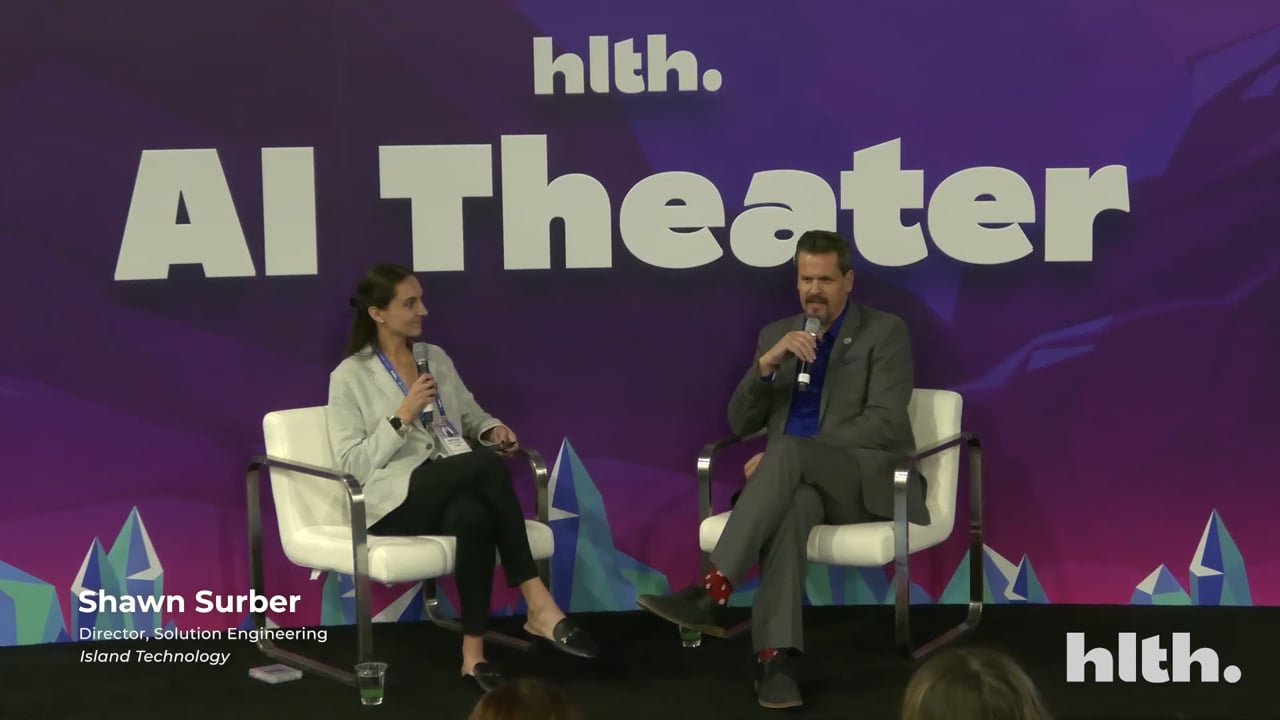
Good afternoon, everyone. How's everyone doing? Good. Come on in and sit down, folks. Got a couple of extra chairs up at the front. Don't be shy. All right, everyone, I'm absolutely thrilled to be here in Vegas with you all. When I got asked to come and speak at this conference, one of the 1st things that came to my mind and also one of the 1st things that comes to my mind when I think about Vegas is making a big bet. So today our session is going to be focused on a big bet that we're placing in the industry, on agentic AI, in automation. And specifically how both of those can help empower our teams by automating routine repetitive tasks and giving them back more time to focus on high value strategic tasks. Now, my name is Brittany Lewandowski. And I have spent the past 6 years supporting AI software, leading teams and also operationalizing AI across customers, helping them transform AI from a buzzword in the industry into a capability that's driving value in production. Today I work at a software company called Island, at Island, we are bringing to market an enterprise browser that is ripe for augmenting your security stack and protecting your mission critical applications and sensitive data. But at Island, what I do is I lead a team that is focused on our AI offerings and how we can leverage islands AI offerings to automate repetitive routine tasks for our customers. Beside me, I have one of my coworkers, Shawn Surber, who has over 15 years of experience in the industry. So, Sean, I'll let you introduce yourself. Thank you. Yeah, I spent 15 years as a system admin and security architect for one of the largest hospital systems in the country.
So I've lived and breathed healthcare now for about 25 years, which is a little painful to say. But since leaving them, I I worked in running healthcare practices at a couple other vendors and got into product management and building products around securing and making available healthcare products and healthcare data. So, we're going to talk a lot about, how how we can use AI, how we are using AI. This is a legitimate case study, way that we're using AI to improve workflows and give clinicians more time with patients.
So I want to start off our session today by sharing a personal story of mine with you all. A month ago, my mom fell and she had a really bad injury. She shattered her shoulder, and ultimately ended up in the ER and had to get a full shoulder replacement. Now, I remember exactly where I was when I got the phone call about my mom's accident. I was responding to Slack messages and emails and I went from doing that to sitting in a hospital chair next to my mom, watching her entire care journey from intake to discharge. Now, during this process, I also got a firsthand account of her care team. And I got to witness how they were manually clicking through a lot of screens, manually managing documentation, and manually copying and pasting the same data about my mom into multiple different portals. Now, undoubtedly, my mom's care team was a brilliant group of individuals, but they all had one common denominator.
They were all drowning in performing routine, deterministic tasks that were ripe for automation. So after I left this experience with my mom. I did some research and I really set out to determine, all right, what is the time allocation look like for healthcare providers on a given day? And I found a recent study published by PubMed that had some astounding results. I found a 44% of healthcare provider's time is spent on EHR related tasks, whether that's managing documentation, charting, or even manually clicking through screens. Again, time not spent connecting with patients. Add on to that, an additional 5% of time is dedicated to administrative tasks. So put that, those 2 pieces together, and our providers are spending roughly half of their days on non-direct patient related tasks. Now imagine what we could do if we could give back these care teams, even half of this time.
Now, what would that mean to them? And more importantly, what would that mean to the industry and to their patients? Now I want to be clear. The challenges that I've discussed so far are not only related to the healthcare space. I've witnessed firsthand that employees across every industry are bogged down performing these routine repetitive tasks. Now, what I'm seeing in the industry is that companies are using agentic AI and automation in order to overcome these challenges, specifically, take retail and e-commerce, for example, where agentic AI and automation is being leveraged to aggregate deals and analyze prices in real time in order to help those companies remain competitive. Consider the hospitality and travel industry, where agentic AI is being leveraged to automate the process of building out campaigns and personalizing outreach, allowing employees to spend time on curating the best possible guest experience.
And finally, consider property management space. Where agentic AI and automation is being leveraged to automate the process of capturing leads and following up with them, to ensure that no opportunity gets left untouched, and allowing employees within that space to focus on what truly matters for them, which is closing deals. It's an interesting thing because healthcare, technology, and healthcare has a tendency to, you know, to fall behind, because all of these organizations are looking at ways to enhance their profit margin. And so there are, you know, immediate feedback on the way this works. But every single one of these items, that's that's the thing they have in common, which is they allow, using this automation, allows their employees to focus on their actual core job. Spending less time doing the things that allow them to do their job and just actually doing their job.
So our focus on that in healthcare is exactly the same thing. If we can automate this, then we give the clinicians more time with the patients, and maybe they see more patients in the hospitals and providers make more money, and that's great too. But the goal here is reduce errors, and reduce time spent on these repetitive actions so that the clinicians can be clinicians. I've spent 20 years trying to just let clinicians be clinicians, not worrying about cybersecurity, not worrying about all of this other various and sundry things that they've got to deal with. So how are these industries being successful with the agentic AI and automation? How is this being deployed? Oh, well, one way is through the browser itself. So deploying agentic AI in a familiar environment to users, which means that people like yourself or anyone on your team, go into a browser, build out a workflow that can automate these tasks, and with a single click of a button, have a task completely automated for a team. Where this translates from a business value statement perspective is what exactly Sean was just touching on.
What this means is that we're bringing automation at scale in a familiar environment to users. Additionally, this means that they will have more time to spend caring with their patients than on performing repetitive routine tasks.
Now, thinking about where we've seen success with customers adopting agentic AI. We have worked with customers to automate the end-to-end process of posting and launching social media campaigns. So when you think about AI, combing through an Excel spreadsheet and gathering details required for a social media campaign and then and then uploading them to YouTube. So thank, video name, video description, thumbnail, link, closed captions, the visibility of the video, taking all of those details from an Excel spreadsheet and automating that whole upload process for a team without a human intervention required at all. Now, I think about it for a second. YouTube campaigns, right? Like, why, why would anybody here care? Every company represented here has a social media team, every hospital has a social media team anymore because you've got to do that.
You've got to reach out. You know, I live, I live in a town with 2 major hospitals and they are constantly battling for, you know, for market share, right? So these are the sorts of things that, again, it's not a level of expertise necessarily that a, a physician practice, has or a, a startup that's just trying to get things going. So being able to use the AI to do the grunt work allows you to have a vision and then execute it without having to know how to do every step of the way. And that's really, that's the difference between agentic AI and traditional AI. Is you teach the agentic AI skills and then it can go and actually take actions, you know, thoughtfully, I hate to use that word, but it can take actions thoughtfully rather than just repeating the exact same steps, which is, you know, kind of the traditional automation motto. Absolutely.
We've also worked with support teams to automate the process of triaging tickets and in responding to those tickets. What this means for support personnel is they can spend more time on complex cases as opposed to triaging ticketing cues. Then finally, I just want to say, and think about that every time a nurse calls the helpdesk. They're not taking care of a patient. And so if they're on hold waiting or they're trying to explain what was going on, that's more wasted time for them. And by embedding the things like the AI capabilities directly in their workspace, because a lot of these users are working in browser-based EHRs and PACS and things like that, by embedding this functionality into their workspace, it can actually identify the problems and help them fix the problems without calling the helpdesk. So not only, like shortening helpdesk response times, but eliminating those calls entirely. Absolutely. And similarly, we've worked with marketing teams to automate the process of creating and deploying advertising catalogs as well.
Now, I want to be clear that all of these applications here. These are not hypothetical. These are use cases that are currently in production with customers that are driving value. Now, how do we translate this into, you know, when we think about the the impact that AI has and, the ROI that it delivers to the business? know, what does that look like? Well, we have helped our customers to return over 15 hours per day to their staff. The one customer that we worked with had a team of about 5 individuals where we were able to give back all of that time, so again, that they could focus on higher value and strategic priorities. I mean, you think about that. That's like they got to hire 2 new people for free. That's not insignificant in a small team. Similarly, we have helped our customers to reduce data entry errors. So improved data accuracy means reduced manual reentry or manual rework.
I want, this one's a big one for me. Data errors kill people. And so, I, 99% reduction data entry errors. That's like, you know, for a regular company, that's efficiency gains and they're happy about that. For healthcare providers, that's better outcomes. That's reduced liability. That's reduced. You know, reinfection rates, you know, ensuring that that data is always accurate, is absolutely critical. And last but not least, we're also supporting improved compliance. We're helping our customers to standardize processes, thus reducing risk, and also reducing risk of audits and the burden that comes with that. So now that we have an idea of the use cases that we are seeing real value from in the industry, how can we extrapolate those to the healthcare space? Well, with automation in the agentic AI in healthcare and really in all facets, we are not focused on being reactive.
We are focused on how can we be proactive. So when you think about that, imagine AI, that could alert care teams to incomplete pre-visit requirements for patients. So imagine if I, as a provider, was given heads up that a patient's form contained, you know, incomplete, or was incomplete, or there was a, a scan that was missing from their chart. And I was able to have advanced notice of that before the patient even walks through the door. Think of the value that that drives. Raise your hand if you've ever been to a doctor's office and had to fill out all of the forms all over again every time, right? Yeah, yeah, yeah, yeah. No. I should have said, don't raise your hand. Yeah, I can't, that would have been easier on everybody. So what if an AI was looking at that? And not just saying, oh, hey, you missed a form. The system can automatically do that, but it says, hey, you missing some prescriptions or you've got the wrong dosage listed because I have your complete medical record.
I know what you should be doing. So now I can flag that to the clinician to have that conversation, so they do it at intake. They do it in advance, be an email to the, to the, to the patient, or they do it directly in the room with the clinician, and, you know, the, it gives the clinician a breakdown of, these are the things you need to discuss before you even get into anything else. And you just touched on it a bit too, Sean. Another great use case in the healthcare spaces, leveraging agentic AI and automation to automate the process of medication reconciliation, and automate the process of performing drug interaction checks in real time, reducing risk, right? I once bought an entire system just to track, an alert, pharmacist on adverse drug interactions. You know, just like, this ability to do these things now in real time. is is absolutely incredible.
It's just going to continue to to drive better outcomes. And finally, perhaps the most impactful is leveraging agentic AI to automate the process of performing clinical documentation, you know, giving teams back hours that they spend charting to focus on patient care. Now, what does that mean? This is where we truly see AI from transforming from being a tool to being a teammate. Yeah, so imagine, your session with your patient, your clinician in the room is recorded. And when it's done, the AI provides a summary. It provides next steps. It provides any prescriptions. The doctor said, hey, I'm going to write this for you, yada, yada, yada. I had an experience recently where I went to the doctor. It gave me 3 prescriptions. I went to the pharmacy and they had two. He forgot to send one in, right? So the, by tying the, the AI into this workflow, we can ensure that the, the doctor knows to follow up on everything that needs doing.
And then also it can generate instructions for the patient. Because I, I, doctors visits are stressful. Hospital visits are worse. You walk out, you, you know, you walk out with a stack of papers or they've told you a bunch of stuff to do, and by the time you reach your car, you've forgotten half of it, right? Let's ensure that you've got the right thing and it's not generic. It is specific to you. They hand you a sheet of exercises to do for your shoulder, but they're like, okay, do this one, but do it, you know, 6 more times than it says on here. Don't do this one. They're crossing stuff off on the paper. Let's give people customized defined documentation. So, and then the the physician walks out the door. Their transcription is done. They're, prescriptions are automatically sent in because the agentic AI can do that for them, build the whole process out, and then leave you sitting on a button that just says approved.
So it doesn't have to be fully automated. We don't have to trust the machines entirely. We want that human interaction. Same thing for when you're sending out emails or marketing campaigns, right? You want human eyes on it the last second. But why are you spending all that time writing it? Why are you spending all that time clicking buttons and going through screens? So this is absolutely huge because so much time is wasted just in that documentation piece.
So thank you all for coming to our session today. If there's one thing that you take away from our conversation, it's that we've placed a big bet in the industry on agentic AI and automation, and it is delivering significant value to customers. So if you have any questions about what we've discussed today or if you wanted to run through certain ideas that you have about how you could automate tasks within your teams, please come find Sean and I. Booth 4036 right over here, come by and we'll show you how all this stuff works. Thanks everyone.
Take your next step.