.svg)

Key takeaways
- Enterprise AI usage now spans five distinct entry points: browser-based AI destinations, agentic AI browsers, desktop AI applications, AI browser extensions, and AI connections to enterprise systems via protocols like MCP.
- Most AI monitoring tools were built for web traffic inspection and cover only one or two of these five entry points, leaving desktop apps, extensions, and agentic browsers invisible.
- Effective AI governance requires architectural visibility across all five entry points from a single policy layer, not a patchwork of network proxies, endpoint agents, and browser extensions.
- Organizations that shift from monitoring AI traffic to governing the environment where AI runs can enable AI adoption without sacrificing data protection or compliance.
Most enterprises are monitoring AI in one lane of a five-lane highway
The security team approved ChatGPT Enterprise. They wrote an acceptable use policy. They deployed a monitoring tool that inspects web traffic for AI-bound data. And yet, six months later, the CISO still can't answer a basic question: where is sensitive data flowing to AI?
The policy is in place. The visibility isn't. That gap exists because AI usage doesn't happen in one place anymore. It happens across five distinct entry points, and the monitoring toolchain most organizations rely on was built for just one of them.
Here are the five AI entry points enterprises need to account for:
- Browser-based AI destinations: Web applications like ChatGPT, Claude, Gemini, and Perplexity accessed through a standard browser.
- Agentic AI browsers: Dedicated AI-native browsers that employees download on their own, often outside IT's visibility.
- Desktop AI applications: Tools like Copilot integrated into the operating system or running as standalone desktop apps with direct API connections.
- AI browser extensions: Hundreds of extensions available in browser marketplaces, installable with a single click, frequently without IT approval.
- AI connections to enterprise systems: Protocols like MCP and direct API integrations that feed enterprise data to AI models programmatically.
According to Microsoft's 2025 Work Trend Index, 75% of knowledge workers now use AI on the job, and 46% started within the past six months. That adoption is spreading across all five entry points simultaneously. Meanwhile, a Gartner survey of 302 cybersecurity leaders found that 69% of organizations suspect or have confirmed evidence of employees using prohibited public GenAI tools.
The five-entry-point model explains why governance still feels incomplete even when the policy is sound. Most monitoring tools cover the first entry point (browser-based web traffic). The other four grow unchecked.
Network proxies, endpoint agents, and extensions each miss different entry points
Security teams that recognize the coverage gap often respond by layering tools. A network proxy handles web traffic. An endpoint agent watches desktop activity. A browser extension monitors in-session behavior. Three tools, three policy engines, and the gaps persist because each architecture was designed for a different problem.
Network-based approaches (secure web gateways, CASBs, SASE proxies) were built to inspect web traffic. They served that purpose well when AI meant browser-based SaaS applications. These tools see entry point one (browser-based AI destinations) and partially see entry point five (API integrations routed through the network). They miss agentic AI browsers that bypass proxy configurations, desktop AI applications making direct API calls that never traverse the network, and browser extensions operating within the session itself.
Endpoint agent approaches (DLP agents, EDR tools with AI-aware rules) can observe desktop application activity, covering entry point three. But they typically lack context about what happens inside browser sessions and can't meaningfully inspect extension-level behavior or MCP protocol traffic.
Extension-based approaches see only the activity within their own extension context in entry point one. They have no visibility into desktop apps, other extensions, agentic browsers, or system-level API connections.
Here's how the coverage maps:
None of these approaches were designed poorly. Network proxies were correct when web traffic was the primary vector for data movement. Endpoint agents were correct when desktop applications were locally installed software with predictable behavior. The problem isn't that these tools are inadequate; it's that AI adoption has moved past the architecture they were built to monitor. They see what they were designed to see. AI started running in places they weren't built to look.
As Gartner noted in November 2025, GenAI creates critical blind spots that CIOs must urgently address, with shadow AI ranking among the most pressing. Gartner predicts that by 2030, more than 40% of enterprises will experience security or compliance incidents linked to unauthorized shadow AI.
What changes when governance lives where AI runs
The monitoring gap described above isn't a tool problem. It's a layer problem. Governance tools are operating at the network layer or endpoint layer, but AI usage increasingly lives at the application layer: within browsers, desktop apps, and extensions. The tools and the activity they're meant to govern occupy different architectural positions.
When governance is embedded in the work environment itself (the layer where employees actually interact with AI), it can observe all five entry points without requiring separate tools for each one. The work environment is the common thread. Whether someone opens a browser-based AI tool, launches a desktop application, installs an extension, or connects an AI model to enterprise data through MCP, that activity passes through the workspace where it happens.
This architectural shift changes what's possible:
- Shadow AI discovery without network log parsing: The environment sees every AI tool accessed, regardless of how it connects, because access originates from within the workspace.
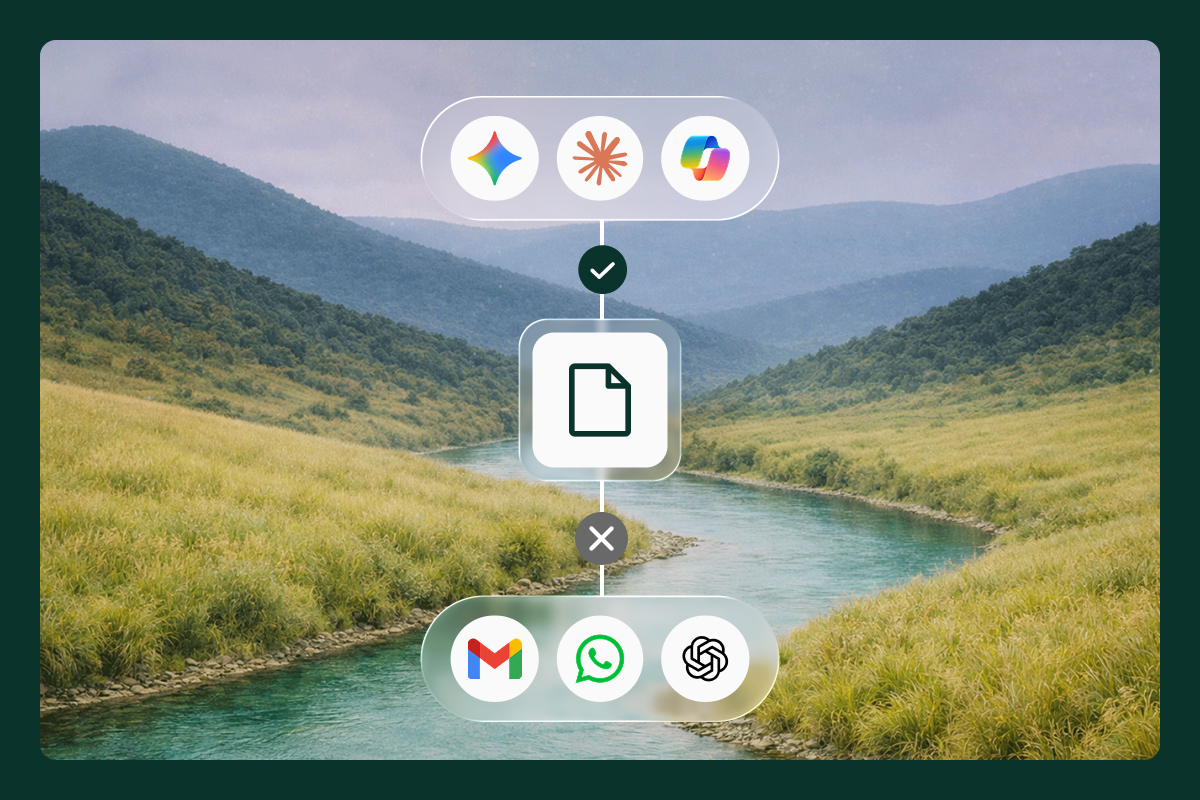
- Real-time data protection: Sensitive content is inspected before it reaches the AI provider, not after it traverses the network and gets flagged in a retrospective report.
- Identity-aware policy: Governance decisions factor in who the user is, what role they hold, and what they're trying to accomplish, not just which domain they're visiting.
- Unified audit trail: A single log captures AI interactions across all five entry points, replacing the task of correlating five separate systems through a SIEM.
Here's the evaluation question most teams skip: when assessing an AI monitoring tool, ask which of the five entry points it can see natively. If the answer is fewer than three, the tool addresses part of the problem and creates the illusion of full coverage. Partial visibility with high confidence is more dangerous than low visibility with honest uncertainty.
AI governance that enables adoption instead of restricting it
Every security leader has fielded the request from a business unit: "We need access to this AI tool by next quarter." The instinct is to slow things down, run an evaluation, add conditions. But the longer the answer is "not yet," the more likely employees find their own path to AI, outside IT's visibility entirely.
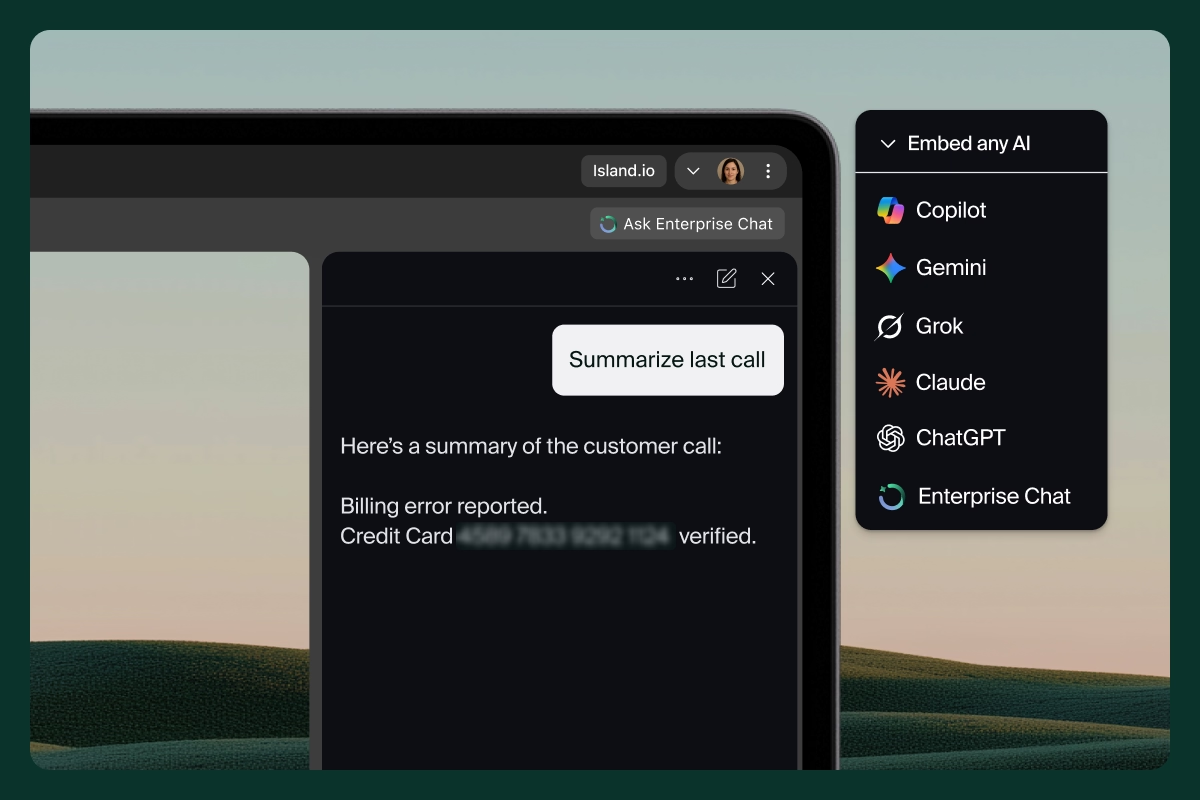
Island Enterprise AI was designed around the five-entry-point model. Its AI Protect capability provides visibility, governance, and data protection across browser-based AI, desktop AI applications, AI browser extensions, agentic AI browsers, and MCP connections from a single environment. The goal isn't to restrict AI usage. It's to create the conditions where security teams can confidently say yes to AI because every interaction is visible, every policy is enforced, and every sensitive data flow is protected before it leaves.
That means corporate versus personal tenant awareness, so security teams can distinguish whether an employee is using ChatGPT through the company account or a personal login. It means extension management that gives IT control over which AI extensions can install and what data they can access. It means prompt-level audit logging where every AI interaction, including MCP calls, is captured for compliance and investigation. And it means sensitive data redaction where content is inspected and protected before it reaches the AI provider.
Island serves enterprises including Global 1000 organizations that need AI governance without friction, enabling teams to adopt AI at the pace the business demands while security maintains full visibility across every entry point.
This is what happens when governance is built into the environment where work happens, not bolted on from outside. The monitoring doesn't feel like monitoring. Security doesn't feel like restriction. It feels like the organization finally has the confidence to let AI do what it was adopted to do.
Three questions to ask before selecting an AI monitoring tool
Vendor evaluations for AI monitoring tools often devolve into feature-matrix comparisons: DLP capabilities, CASB integration, extension management, reporting dashboards. Those features matter. But without a structural framework, it's easy to assemble a stack that covers individual capabilities without covering the actual surface area where AI runs.
These three questions cut through that complexity:
- Which of the five AI entry points does this tool cover natively? If a tool requires a separate agent, proxy, or extension for each entry point, it's replicating the fragmented architecture problem rather than solving it. Ask the vendor for a coverage map against all five entry points. A tool that covers two natively and promises the other three through integrations is a tool that inherits the gaps of the tools it integrates with.
- Does the tool share a single policy model across all entry points? Separate policy engines for network, endpoint, and browser create drift. When a CISO defines "block uploads of financial data to AI tools," that rule should apply to a browser-based AI destination, a desktop Copilot session, and an MCP connection without requiring three separate configurations.
- Can the tool distinguish between enabling AI and restricting it? Monitoring tools that only block or allow are built for a binary world. Enterprise AI governance requires nuance: allow this tool for this team, restrict sensitive data for that use case, audit everything but block nothing for executive-approved workflows.
The evaluation mistake most teams make is comparing monitoring tools on feature lists without mapping those features to entry points. A tool with excellent DLP but no desktop app visibility solves half the problem and obscures the other half. Ask the vendor to walk through a scenario where an employee uses four different AI tools in a single workday and show what's visible at each step.
AI entry points will keep multiplying. Agentic AI, MCP, and desktop-native AI assistants are accelerating faster than most governance roadmaps anticipated. The monitoring architecture chosen today needs to handle entry points that don't exist yet.
FAQs
What are the five AI entry points enterprises need to monitor?
Browser-based AI destinations, agentic AI browsers, desktop AI applications, AI browser extensions, and AI connections to enterprise systems via protocols like MCP. Most monitoring tools cover only the first.
Why don't traditional AI monitoring tools cover all five entry points?
Network-based tools were built to inspect web traffic, not desktop applications or browser extensions. Endpoint agents lack browser-session context, and extension-based tools see only their own extension's activity.
How can organizations prevent data leakage to AI tools without blocking AI entirely?
By embedding data protection in the environment where AI runs, organizations can inspect and redact sensitive content before it reaches an AI provider while still enabling approved AI usage across all entry points.
What should I look for in an AI monitoring tool?
Native coverage across all five AI entry points, a single unified policy model that applies across browser, desktop, and extension usage, and the ability to enable AI adoption with granular controls rather than binary allow-or-block rules.
If you're evaluating how your current monitoring architecture maps to these five entry points, we're happy to walk through what we've built. Schedule a demo.

Island is the ideal environment for enterprise work. Its Enterprise Platform unifies and embeds core modern work requirements like enterprise AI, network, and data protection directly into the browser, desktop, or anywhere work happens. With it, organizations see, control, and protect all work activity while users enjoy a smooth, seamless, AI-powered experience.


.svg)
.svg)
